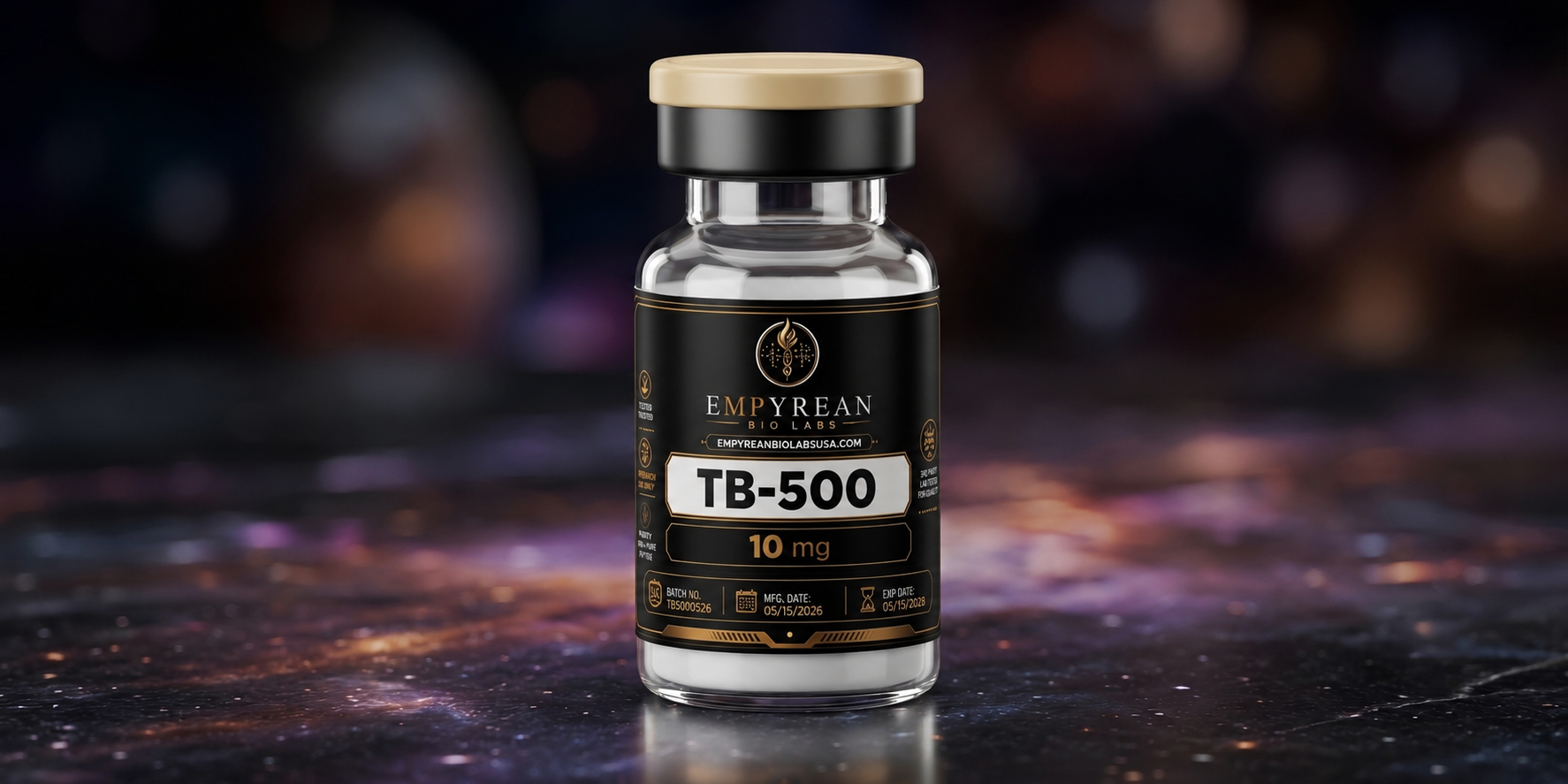
TB-500
$60.00 Original price was: $60.00.$55.00Current price is: $55.00.
A repair-focused peptide associated with thymosin-beta-4 biology, including cell migration, blood-vessel development, flexibility, tissue remodeling, wound closure, and broad soft-tissue recovery. It is especially popular in research involving muscular, connective-tissue, and dermal repair pathways.
Research Details
TB-500
Scientific Research Overview
TB-500 is generally identified as the synthetic seven-amino-acid thymosin beta-4 fragment LKKTETQ, with an acetyl group attached to its N-terminal leucine. It is chemically distinct from full-length thymosin beta-4, a naturally occurring 43-amino-acid peptide involved in actin regulation, cellular migration, inflammatory signaling, and tissue-repair processes.
Research interest in TB-500 largely comes from its relationship to a biologically active region of thymosin beta-4. However, findings produced with full-length thymosin beta-4 cannot automatically be attributed to TB-500.
Published Research Findings
Direct experimental evidence for TB-500 itself remains extremely limited. In its 2026 scientific review, FDA reported that it did not identify in-vivo studies demonstrating that TB-500 promotes wound healing.
An in-vitro scratch-wound study reviewed by FDA found that the parent TB-500 peptide did not directly induce wound closure under the tested conditions. However, one TB-500 metabolite, N-acetylated LKKTE, showed wound-healing activity in vitro. The biological relevance and reproducibility of that metabolite finding remain uncertain.
Related Thymosin Beta-4 Research
Positive research frequently associated with TB-500 generally involves full-length thymosin beta-4.
In a rat full-thickness wound model, full-length thymosin beta-4 increased re-epithelialization, collagen deposition, and angiogenic activity, producing faster wound healing than control treatment.
Prospective clinical research involving topical full-length thymosin beta-4 has also examined venous and pressure ulcers. Early controlled studies reported acceptable tolerability and encouraging signals for accelerated dermal repair, although these findings involved topical thymosin beta-4 formulations—not injectable TB-500.
Preclinical corneal research found that full-length thymosin beta-4 supported epithelial migration, reduced inflammatory activity, and accelerated corneal wound closure in experimental injury models. Again, this evidence applies to thymosin beta-4 and should not be represented as direct proof for TB-500.
Evidence and Regulatory Context
TB-500 is not an FDA-approved drug. FDA’s 2026 review found:
No identified human exposure studies involving TB-500 drug products
No direct human efficacy evidence
No established acute or repeated-dose toxicity profile
No reproductive, developmental, genotoxicity, or carcinogenicity studies
Potential concerns involving immunogenicity, aggregation, impurities, and chemical characterization
FDA concluded that available evidence was insufficient to establish TB-500’s safety or effectiveness for wound healing. The peptide was discussed by the Pharmacy Compounding Advisory Committee in July 2026, but advisory consideration does not itself constitute FDA approval.
Research Links
Direct TB-500 information
FDA scientific review of TB-500 free base and TB-500 acetate
FDA safety information concerning TB-500 and other bulk peptide substances
Analytical research on TB-500 and its metabolites
Related full-length thymosin beta-4 research
Thymosin beta-4 and experimental wound healing
Thymosin beta-4 and venous-ulcer research
Prospective thymosin beta-4 venous-ulcer study
Thymosin beta-4 and experimental corneal wound healing
ClinicalTrials.gov study of thymosin beta-4 for pressure ulcers
Research Context: TB-500 is chemically distinct from full-length thymosin beta-4. Findings involving thymosin beta-4 are presented only as related mechanistic research and do not establish equivalent activity, safety, effectiveness, or clinical behavior for TB-500. Published findings do not establish the identity, purity, sterility, safety, effectiveness, or regulatory status of the research material offered on this page. This product is sold strictly for lawful laboratory research and is not intended for human or veterinary use.
Vial10 mg
StorageStorage Information: Store lyophilized research material tightly sealed, dry, and protected from light at -4°F (-20°C) or below for long-term stability. After laboratory preparation, store in small aliquots according to the product and avoid repeated freeze-thaw cycles; allow cold vials to reach room temperature before opening to minimize condensation.
Compliance Notice: For research use only. Not for human consumption. Not intended to diagnose, treat, cure, or prevent any disease. Products and information are intended for qualified adult researchers only.
Description
TB-500 is a repair-focused peptide associated with the regenerative biology of thymosin beta-4. Thymosin beta-4 plays an important role in actin regulation, allowing cells to move, reorganize, and participate in tissue restoration. This biology has generated strong research interest in cell migration, angiogenesis, wound closure, flexibility, inflammation modulation, stem-cell mobilization, and the regeneration of damaged muscular, dermal, and connective tissues.
Research involving thymosin beta-4 has shown accelerated wound repair, improved re-epithelialization, enhanced blood-vessel development, and supportive effects across skin, corneal, cardiac, and soft-tissue models. Its ability to encourage repair cells to reach injured areas makes the TB-500 pathway especially appealing for studies involving muscle strains, tendon and ligament stress, mobility, flexibility, and broad recovery. TB-500 is frequently paired with BPC-157 because the two compounds approach restoration through complementary biological pathways—one emphasizing organized tissue repair and the other emphasizing cellular movement and regenerative coordination.
Reviews
There are no reviews yet.